Friday, 8 November 2024

35 on Sky


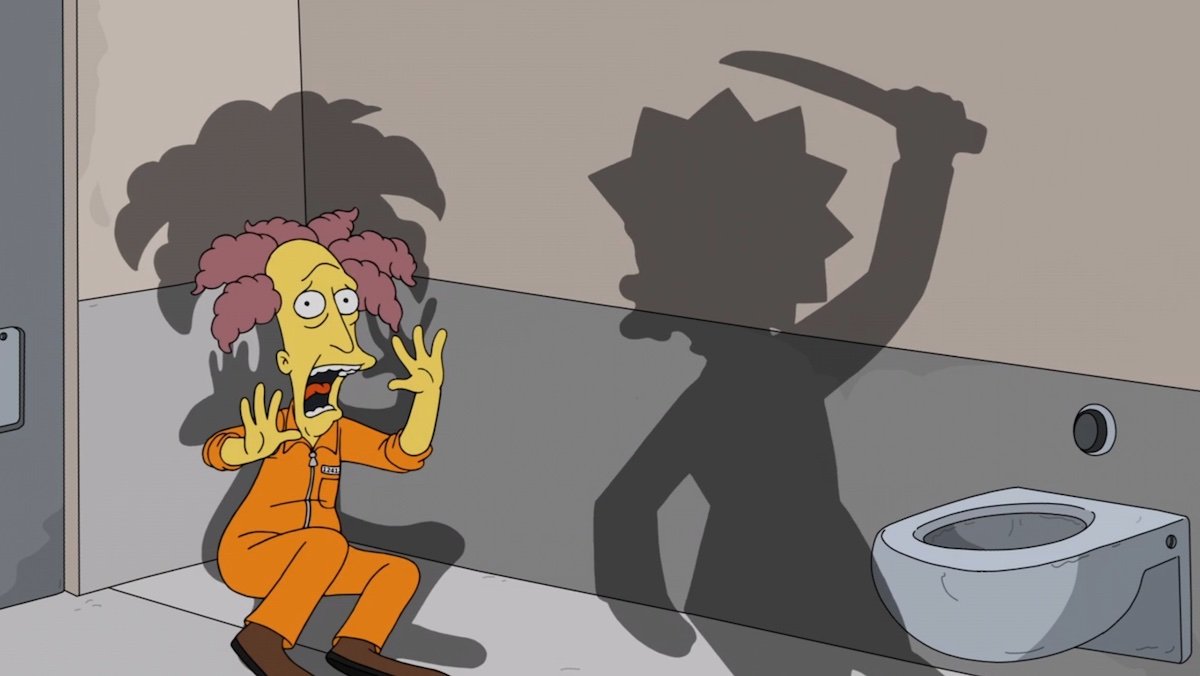
Between January 14th and June 2nd of this year, Sky Showcase brought the abbreviated 18-episode Season 35 of The Simpsons to British viewers... with one exception. Yes, for the second year running, the annual Treehouse of Horror -- number XXXIV -- was held back to Halloween, specifically October 27th at 7.30pm. I have to assume the only reason for this is, after they had no problem with airing the first thirty-two Halloween specials out of season, Sky want to make sure they'll be seen on Halloween itself or near enough. Heaven knows how they will cope with Season 36, which has two spooky specials, the usual Treehouse and "Treehouse of Horror Presents: Simpsons Wicked This Way Comes", a trilogy based around the works of Ray Bradbury.

There were two scheduled repeats: Wednesday 30th at 10pm, and Halloween itself at 7.30pm. I would be 99.9% sure that late-night repeat on the 30th reinstated all of the material cut from the earlier screenings, but in testament to my professionalism I forgot to make a recording of that one. Because, yes, there were cuts, all of which were to the second segment, "Ei8ht":
  • When Nelson and Lisa enter the slaughterhouse, Nelson is killed by the unseen murderer right after his line "Hey, meat hooks, hook meat much? Haw-haw!"; in the uncut version a meat hook then bursts through the back of his head and out through his mouth, but Sky cut away just as the impact is beginning, so we see a tiny bit of blood but no more
  • When Lisa plays this back on the security footage about half a minute later, a similar edit happens, so the viewer gets the gist but there is no actual impact.
  • When Lisa gets thrown into Sideshow Bob's cell about a minute later, there's a montage of all the other murders she committed; Martin's death seems to be trimmed, and the Spuckler kid and Sherri's removed entirely.
Whilst these edits certainly reduce the amount of violence, this is an incredibly graphic segment and a huge amount of blood, gore and lingering shots of corpses were left in, with only the actual killings getting censored! This was the only episode of Season 35 Sky cut at all, with even the dreaded word "bastard" being left in on multiple occasions in other episodes that premiered at 6.30pm. Whilst Sky dealt with this specific episode pretty well, I find their red lines and approach to scheduling more than a little baffling.

Sunday, 3 November 2024

Turn to 400


In 1982, the British game designer Steve Jackson is editing the first Fighting Fantasy adventure gamebook, which he has co-authored with Ian Livingstone, The Warlock of Firetop Mountain. As he brings together his half of the book with Livingstone's, he notices that quite by chance, there are 399 numbered references in the adventure -- a number which is just begging to be rounded up to a nice, whole 400. So Jackson duly does so, adding an extra reference which is not accessible from any of the others and is there just to make up the numbers. The number sticks, and 400 references becomes the standard used for the vast majority of the 70+ books that will be published in the series over the next 42 years, with 'turn to 400' becoming synonymous with victory.


In 1984, though, the Fighting Fantasy range opens up to freelance writers, it having become apparent that Jackson and Livingstone cannot keep the best-selling series going on their own. The first book from an outside writer is by the American game designer Steve Jackson, a book called Scorpion Swamp. The American Jackson's book differs from what has come before in many regards, but crucially, it has multiple possible solutions owing to its premise that the player character can accept one of three missions from three different wizards before entering the titular swamp. Hence, in this book, section 400 is just a section like any other, not tied to victory or even a game over. Jackson USA would use a similar approach on the other two gamebooks he wrote for the series, Demons of the Deep (where the goal is always the same but you have multiple different options and approaches for the book's endgame) and the science-fiction based Robot Commando (which is somewhere inbetween the two, giving you complete freedom to go wherever you like and offering several entirely different ways of winning the game by defeating the invading forces).

There are a few other books where section 400 does not see you emerge from your adventure victorious, two of which were written or co-written by Paul Mason. No, not that Paul Mason.


Both of these books were published later on in the series' run, and are notable for their unusually mature writing and complex gameplay; in particular, The Crimson Tide has several unusual non-fatal endings such as giving up your quest for revenge to become a monk, although there is one 'golden' ending which is clearly preferable to all others. In both cases, Mason (or his co-author, Steve Williams, with whom he wrote Black Vein Prophecy) also appears to use the placement of section 400 to actively if lightly troll the reader.

Sunday, 20 October 2024

Excellent Fun From the Noisiest Basement


The Wayne's World sketches on Saturday Night Live, chronicling the adventures of metalhead Wayne Campbell and his friend Garth Algar as they hosted a public-access television show from his parents' basement, ran from 1989 to 1994 (the character having originated on the CBC variety series It's Only Rock & Roll two years earlier), inspiring the surprise hit film of the same name in 1992 (by some distance the most successful film based on an SNL sketch) and its sequel a year later. Wikipedia's article on the sketches states the following:

In the United Kingdom, where Saturday Night Live is rarely shown, Wayne's World sketches were extracted from SNL broadcasts and individually packaged as 10-minute episodes which aired on BBC Two as part of the DEF II programming strand, simply as a tie-in with both Wayne's World movies.

But you're not happy just knowing that, are you?

DEF II was an early-evening programming strand aimed at teenagers which broadcast twice weekly between 1988 and 1994. It frequently featured American imports ranging from The Fresh Prince of Bel-Air to Mission: Impossible, and, yes, in 1992 the Wayne's World sketches were the first Saturday Night Live material to be seen on the BBC. Consulting BBC Genome, we can see that the descriptions of each broadcast in the Radio Times (Britain's premier TV listings magazine, for any Americans reading) were as follows:

1. 2 September 1992: The original sketches from America's famous Saturday Night Live TV series that inspired the teen film Wayne's World and countless catchphrases. It's bogus.... not!
2. 9 September 1992: More excellent fun from the noisiest basement in Aurora, Illinois. Join Wayne, Garth and a celebrity guest partying on down. It's all babelicious fun.... not!
3. 16 September 1992: More excellent fun from the noisiest basement in Aurora, Illinois. Join Wayne, Garth and a celebrity guest partying on down.
4. 23 September 1992: More fun from the noisiest basement in Aurora, Illinois.
5. 30 September 1992: More fun from Aurora, Illinois, as Tom Hanks plays Aerosmith's head roadie.
6. 7 October 1992: More fun from Aurora, Illinois. With actress Debra Winger.
7. 14 October 1992: More fun from Aurora, Illinois.
8. 21 October 1992: Mary Tyler-Moore is the new babe in the basement.
9. 28 October 1992: Last in the series from Wayne and Garth's basement.

Saturday, 19 October 2024

The Edge of Forever


Several years ago, I had a little mystery regarding the 1988 film Just Ask for Diamond. You can go here for a full refresher, but in short, I am in possession of two substantially different versions of the film: the one that was originally released on VHS, and another one which has many cuts and edits, which is the one currently available on DVD.

There was also another version of Just Ask for Diamond for the American market, which retitled it Diamond's Edge, but I didn't have access to a copy of that.

Until now, when someone has uploaded the whole damn thing to YouTube. I feel a bit grubby about linking to such a thing, but search for 'Diamonds Edge / Just Ask For Diamond 1988' and it should come up. We can now see the alternate title card in the opening sequence:


Crucially, though, this American edit is the short version with all the cuts, but one further difference -- the original opening theme ("Just Ask for Diamond" by the Wee Papa Girl Rappers) has been replaced with an instrumental piece, pretty much the same one used on the closing credits of the short edit. The American version also cuts one of the credit screens from the opening sequence, the one right after the title card which reads 'With ROBERT BATHURST. / GERALD CAMPION. / DONALD STANDEN.'; I can only presume this is because none of these people were particularly well-known in the US.

The version currently available on DVD appears to be this version, but with the original opening titles spliced in somehow. Is it mere accident that this one ended up on British home media in the first place? Is it possible that the DVD company got mistakenly handed this edit, someone noticed the issue with the title and they just grabbed a copy of the original opening titles to edit in and assumed that would be OK? There's still some leaps of logic here -- when they were given the original version, why would they not just use that one instead of creating this weird hybrid? -- but it feels like a significant piece of the puzzle has fallen into place.

Thursday, 17 October 2024

The Eve of the Wars

In January 2001, the tenth issue of Robot Wars Magazine has exciting news for robo-nutcakes everywhere:


The problem is that this planned night of programming never actually happened. Maybe the BBC lost interest in theme nights overall, maybe the fan-submitted footage they were getting wasn't good enough. But did any remnants of the planned Robot Wars Night survive?

Well... not definitely. I don't have a smoking flamethrower here or anything. But there are a few curiosities floating around from around this time that might be related.

Sunday, 13 October 2024

Your Number's Up


In 1982, Steve Jackson and Ian Livingstone popularised the gamebook genre in the United Kingdom with the first Fighting Fantasy adventure, The Warlock of Firetop Mountain -- a book authored by having Livingstone literally write the first half and Jackson the second. Jackson was responsible for the game's final puzzle, and strives to protect the book against cheaters by devising a puzzle where you have to use the numbers associated with certain items to reach sections the book does not let you access normally.

Jackson ran with this tactic by going on to use it in just about every other FF book he wrote; Livingstone also used it on occasion, but in a more... straightforward (for want of a better word) manner. The idea was also used by outside writers (who were employed when it became apparent demand for the series was far outstripping the rate at which Jackson and Livingstone could hope to write by themselves), and by the end of the series the concept was being used in extremely complex ways, in almost impossibly difficult books which were no longer really being aimed at children.

But there's a missing link in my writing on the subject, and therein lies the following question: What is the first book in the range from an outside author to utilise this concept?

Thursday, 10 October 2024

Dwarfing Through the Decades


Having repeated the first two series of Red Dwarf last year -- the first full-on repeat run the show has enjoyed on its channel of origin since 2007, and the first in peak viewing hours since the Remastered episodes were screened in 1998 and 1999 -- BBC Two have picked things up in the last week with a repeat of Series III, which has required me to try and edit the old Red Dwarf BBC Broadcasts Guide without completely fucking up the coding once again.

At the moment this post is published, "Marooned" will just have finished airing -- the seventh time it's been seen on BBC Two overall, which is the joint most times along with "The End" and "Gunmen of the Apocalypse" ("Gunmen" getting two extra outings for Red Dwarf Night and a seemingly random showing in 1999, and the Remastered version of "The End" being shown twice when every other Remastered episode only had the one airing).

But thanks to "Marooned" also getting a one-off airing as part of Two's fiftieth anniversary a decade ago, the episode holds a very interesting record: it has been shown once in the eighties for its original airing, three times in the nineties and once in the noughties for various repeat runs (including in its Remastered form in 1999), once in the twenty-tens and once in the twenty-twenties, all on the same channel it originally aired on.

How many other episodes of television can claim this record?

Sunday, 6 October 2024

Hyde and Seek


The Children's BBC comedy Julia Jekyll and Harriet Hyde, which starred a young Olivia Hallinan as a schoolgirl who involuntarily transforms into a monster after her chemistry project goes wrong, but was otherwise very very loosely based on Robert Louis Stevenson's original novella, ran for three series between 1995 and 1998. It manages to get the word "booze" into its first episode, as part of an admirable commitment to pushing back the boundaries of what is acceptable at quarter past four in the afternoon, as well as some genuinely cutting commentary on the education system.

Unlike its contemporary, Out of Tune, a full set of episodes is available for JJaHH on YouTube. Like Out of Tune, though, the Radio Times seems to have been a bit confused about how many episodes were in its first series. See if you can spot the issue with the original listings:

1. TX 29/09/95: A 13-part comedy series in which a girl undergoes a change of identity.
2. TX 06/10/95: Second of a 13-part comedy series in which a girl undergoes a change of identity. Today, Julia's bossy Aunt Cassandra gets more than she bargained for.
3. TX 13/10/95: Third of a 24-part comedy series in which a girl undergoes a change of identity. It's school play time. Julia is to take the leading role in Beauty and the Beast. But what will Harriet Hyde play?